eCampus funds Georgian digital projects
July 22, 2021
Georgian recently received close to $350,000 from eCampusOntario’s Virtual Learning Strategy funded by the provincial government. This new funding supports our bold digital innovation strategy aimed at providing the best student experience by developing and implementing innovative methods of academic delivery and leveraging technology to provide exceptional service throughout the student journey.
As a leader in these innovative technologies – which we know can play a significant role in making education more accessible in the communities we serve – we’ll continue to ensure our graduates have the digital innovation skillset that today’s employers are looking for.
The funding will support four projects at the college:
- Building a multi-media team to support our digital innovation strategy
- Developing computer drafting video modules for the Kitchen and Bath Design program
- Producing an Artificial Intelligence Open Education Resources (OER) textbook
- Adapting the Communication Essentials course as an OER
The Ontario government is transforming virtual learning by supporting nearly 400 innovative projects at colleges, universities and Indigenous institutes. These projects are part of the province’s Virtual Learning Strategy and will provide students with more flexibility and access to high-quality postsecondary education and retraining opportunities.
THE PROJECTS
Building a multi-media team to support Georgian’s digital innovation strategy
The majority of the funding – $295,600 – will go toward building a dedicated multi-media team to support Georgian’s efforts to enhance and modernize our approach to teaching or learning. We’ll optimize a mix of online, remote, and in-class learning, while providing the best student experience possible.
Georgian wants to continue being a leader in modern education using digital assets and high-quality online learning tools. There are many faculty who want to develop videos and podcasts to use in their classrooms, as well as a need for video resources in other college departments.
“We need a dedicated multi-media team to help with these projects and to enhance the great work that’s already being done in our Centre for Teaching and Learning and through Media Services,” says Jamie Doran, Executive Director, Research, Innovation and Entrepreneurship. “This gives us more tools in our toolbox in order to be more nimble in our digital strategy.”
Details around the multi-media team – which will include a few student co-op positions – will be finalized over the coming weeks.

We need a dedicated multi-media team to help with these projects and to enhance the great work that’s already being done in our Centre for Teaching and Learning and through Media Services, This gives us more tools in our toolbox in order to be more nimble in our digital strategy.
– Jamie Doran, Executive Director, Research, Innovation and Entrepreneurship
Three of the projects are geared toward enhancing digital engagement and OER, which are any type of educational materials in the public domain. They can include textbooks, lecture notes, syllabi, assignments and tests.
Computer drafting video modules for Kitchen and Bath Design
Project outline: The video tutorials will provide an introduction to basic computer software applications used to create kitchen and bath drawings. The modules introduce new design skills such as drawing a basic floor plan, interior elevations, mechanical plan, 3D drawing and drawing presentations. A simple kitchen and/or bath design will be reproduced within the video tutorials.
Who’s involved in the project? The modules will be created by Jennifer Lucifora, Program Co-ordinator, Kitchen and Bath Design, and faculty member Mary Dancey.
Jennifer has taught computer-aided drafting courses using YouTube video learning tutorials successfully for the past five years. As a business owner and educator, she has experience working with multiple design software programs such as AutoCAD, Autodesk Revit, Chief Architect, VR and AR technology both for practical and academic purposes.
Mary was one of the first graduates of Georgian’s Kitchen and Bath program. She’s a business owner and multiple award-winning kitchen and bath designer.
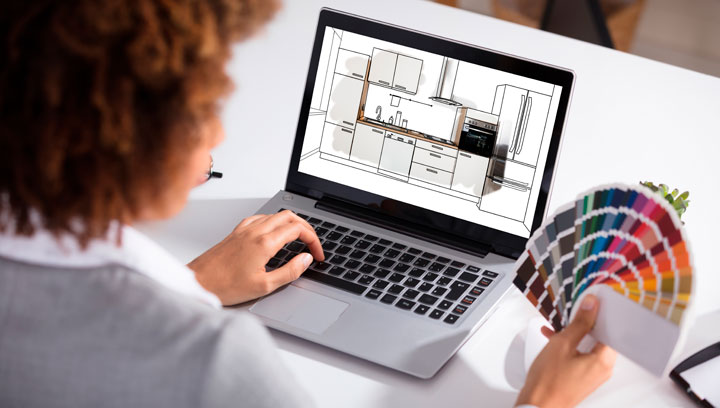
How will this project enhance the student experience? It will provide students and industry workers with a foundation in two industry-standard design software programs (20/20 and Chief Architect), which are used to create kitchen and bathroom design drawings. The added skills on their resumé will help provide employment opportunities for our graduates.
Artificial intelligence (AI) OER textbook
Project outline: This project involves creating an open interactive e-textbook resource. Since it’s open it will be published and freely available for anyone who wants to learn about conversational AI – a set of technologies that enable computers to simulate real conversations. It will be hosted in the province’s digital learning repository. As an open resource, other faculty from any institution can also adapt, modify and use any part of the e-textbook for their own purposes. The material covered in this e-textbook will be a blend of theory and applied knowledge on how to develop conversational AI systems using technologies such as Amazon Alexa, Google Assistant, IBM Watson and Microsoft Azure cognitive services.
Who’s involved in the project? Ross Bigelow, Program Co-ordinator, Artificial Intelligenc – Architecture, Design and Implementation, is authoring the textbook and Professor Jaret Wright will be the reviewer. The Centre for Teaching and Learning will help to ensure the textbook follows best practices around content delivery.

How will it enhance the student experience? This initiative will provide students in our Artificial Intelligence – Architecture, Design and Implementation program with a free, media-rich, interactive learning resource.
Communication Essentials OER adaptation
Project outline: The Liberal Arts department will adapt an existing OER to fulfil the requirements as the main resource for the Communication Essentials (COMM 1016) course at Georgian.
The project’s main goals are:
- to adapt an existing open textbook to cover the required course learning outcomes while providing content that will appeal to students in multiple program areas
- to include interactive elements, such as multiple choice comprehension checks, videos, etc., to motivate students
- to create a test bank for faculty to use as a resource
Who’s involved in the project? The work will be done by Liberal Arts faculty members Linda Thomason, Jen Booth and Amanda Quibell, with input from Communications faculty.

How will it enhance the student experience? Communication Essentials is a required course for all diploma programs and most certificate programs at Georgian. The final product will be a customized resource that’s open(free) and available to students in multiple formats (web textbook, PDF, print version). This open textbook will benefit many students both financially and in terms of instant access to the class textbook.
Other eCampus projects
Lumeto immersive learning platform for health care
eCampus Ontario has chosen a consortium led by Laurentian University, Lumeto, Georgian College and the Michener Institute of Education at the University Health Network to receive $1.1 million in funding for the development of a nursing-focused virtual reality health-care training experience.
The funding will see the consortium develop 12 virtual reality simulation training applications for nursing (RN) and respiratory therapy (RT) students across Ontario.
Rob Theriault, Georgian’s Immersive Technology Lead, says that while the focus is on nursing many of the virtual reality (VR) experiences may also be applicable to advanced-level paramedics. Rob will oversee the virtual reality aspect of the project and look at all 12 from a VR perspective for both fidelity and agency.
“What we mean by agency is what the student needs to do with their hands in each experience – pick up a chart, order lab values, feel a pulse, use a stethoscope – those kinds of things,” says Rob. “And by fidelity we need to ensure that things look accurate. For example, when the student is looking at the patient, does the patient look sick? Do they move in a way so that they look distressed? If there’s a blood pressure cuff on the patient’s arm it needs to be located on the arm properly.”

Rob adds that these VR experiences will enhance students’ lab learning in a more immersive way. While students can get hands-on experience in a lab setting with simulation mannequins, in these VR settings they’re looking at a patient who looks and behaves like a sick patient and can respond to a variety of treatments.
“For example, if you give them medication you’ll see a change in the vital signs and a physiological response,” says Rob.

Jonathan Lee, a part-time instructor in Georgian’s paramedic programs and an Ornge critical care paramedic, is providing support for three of the critical care VR experiences: Pediatric Airway Management, Advanced Airway Management, and Management of a Mechanically Ventilated Patient.
“We looked at what learning outcomes we wanted the students to achieve from the VR experiences and now I’m building the stories for the scenarios to help them achieve those outcomes,” says Jonathan.
He explains that faculty will be able to test students on critical skills like decision making in real-time scenarios.
Rob adds that everyone on the Lumeto project will be reviewing all the VR experiences.
We looked at what learning outcomes we wanted the students to achieve from the VR experiences and now I’m building the stories for the scenarios to help them achieve those outcomes.
– Jonathan Lee, Part-time instructor, Paramedic program
Entrepreneurship
Georgian is also working in collaboration with Durham College, Humber College and Sault College to create a short, four-course micro-credential to provide entrepreneurs and their staff increased education on properly managing sales activities and developing virtual relationships, amongst others.